 After independence, our agricultural policies were influenced greatly by the needs of big landlords. As a result, the needs of the large majority of small peasants were neglected. That is why even after 56 years of independence, three-fourth of our agricultural land remains uneconomical. Because of this lacuna in our agricultural policies, small farmers remain below the poverty line, and our country has not prospered agriculturally. More than 80% of Indian farmers own two and half acre or less land. Their share of cultivated land is about a third of the total available agricultural land in the country. Over time, due to high population growth that causes a division of land holdings, and a very slow growth rate of the rural economy, the pressure on land has been steadily increasing and the number of small and marginal farmers has been growing. These farmers could play a leading role in the development of the country by contributing to the nation’s capital formation if their uneconomic holdings are converted into economic ones. However, with the traditional cropping system, small and marginal farmers are finding it difficult to produce adequate food to feed their families. The only way to convert these holdings into profit-making ones is through the intensive use of land through diversification of crops. Deendayal Research Institute conducted an intensive cultivation experiment on 2.5-acres of land.
Methodology
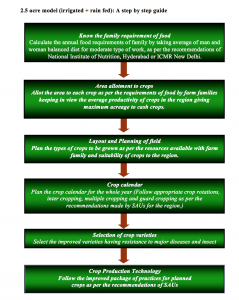
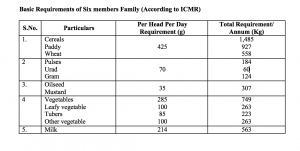
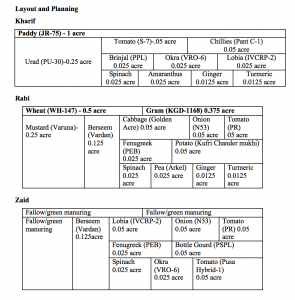
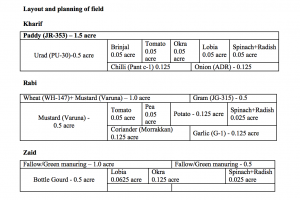
This intensive cultivation experiment on two and half acres of land was undertaken on a farmer’s field at Degrahat village of Majhgawan block in Satna district, M.P., with the active participation of farm family during 2001-02 and 2002-03. The planning and layout of field was done on the basis of the family’s requirement of food. For calculating family requirements of foods per annum, the average of man and woman balanced diet for moderate type of work, which is recommended by National Institute of Nutrition, Hyderabad was considered.
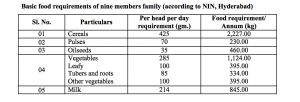
Food requirement of family also includes 20% surplus to meet requirement of seed & family guests.
Results
A substantial increase in yield & income was observed over the traditional system of cropping. This increase in yield & income could be attributed to intensive use of land and diversification of cropping pattern. Where the farmers was finding it difficult to produce adequate food to feed his family with traditional system has now able to save Rs. 14,153 per annum after meeting his family annual expenses. The family income has increase by Rs. 40,457 (Table – 3) over the two years. Also, the intensive cultivation model generated more employment for the farm family throughout the year.
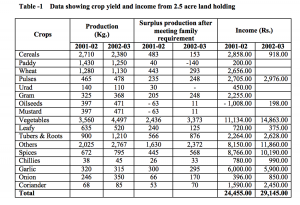
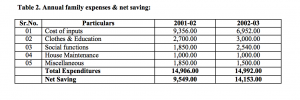
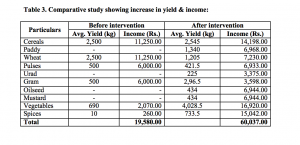
Prices of produce were calculated on the basis of prevailing rates in the local market.
Conclusion:
From the above results it may be concluded that crop diversification by incorporating pulses, oilseeds, vegetables and other cash crops in a scientific cropping pattern can play an important role in increasing farm incomes and employment to achieve nutritional security. Further, as the average family land holdings at the national level have come to 1.6 ha. intervention on 1.5 acre subsistence farming is also needed. Such studies can make a difference to the livelihood as well as food & nutritional security to the people. As such, the focus of extension functionaries should shift to organic farming system diversification.
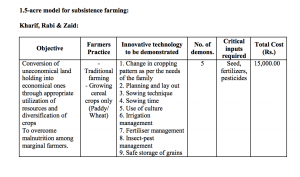
Given below is a template for a 1.5 acre model for marginal farmers.